
Your data architecture problem isn't technical
It's an org chart problem wearing a technology costume

The pattern
Your next data platform migration will fail. Not because of the technology. Because of your org chart.
Digital transformation failure rates range from 70% to 90% depending on who you ask. Globally, these failures cost organizations billions per year. The exact number matters less than the consistency: most of these projects don't deliver what they promised.
We have better tools than ever. Kafka handles real-time streaming at scale. Apache Iceberg brings reliable transactions to data lakes. Flink processes events with strong delivery guarantees. The technology works.
… but something is still missing. Every few years, the industry falls for the same pitch: adopt this architecture, eliminate chaos, achieve a single source of truth. Data mesh. Lakehouses (Hadoop for the older geeks here).
Within two years, the ‘chaos’ returns. Teams spin up analytics pipelines, the ML team builds custom ETL jobs to go faster, spreadsheets are still temporary glue. The architecture fragments along the same lines as before.
Is technology really the problem?
The invisible force
In 2008, architect Ruth Malan wrote something that should be required reading for anyone planning a data platform migration:
"If the architecture of the system and the architecture of the organization are at odds, the architecture of the organization wins."
This is Conway's Law applied to data. Your systems don't reflect your technology choices. They reflect your communication structures.
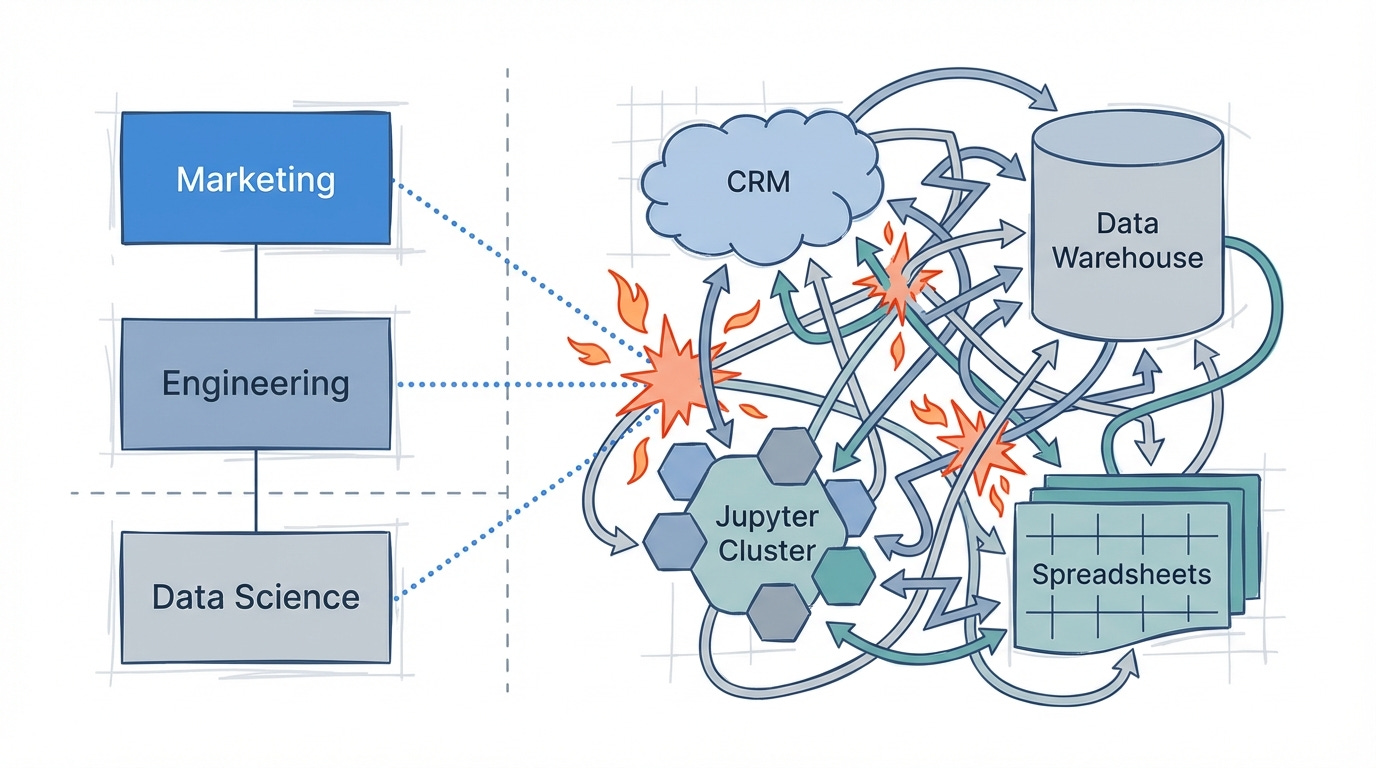
When data teams and software teams report to different executives, you get operational and analytical systems that don't talk to each other.
When marketing, sales, and product have separate data initiatives, you get three copies of customer data with different definitions.
When the data science team operates in isolation, you get a Jupyter cluster pulling directly from production databases because that was the path of least resistance.
These are org chart failures wearing technology costumes.
Jack Vanlightly from Confluent described it well: "When software engineering teams and data teams operate in their own bubbles within their own reporting structures, a kind of tragic comedy ensues where the biggest loser is the business as a whole."
The architecture becomes a fossil record of every communication failure. Each choice makes local sense but create global dysfunction.
The unified architecture trap
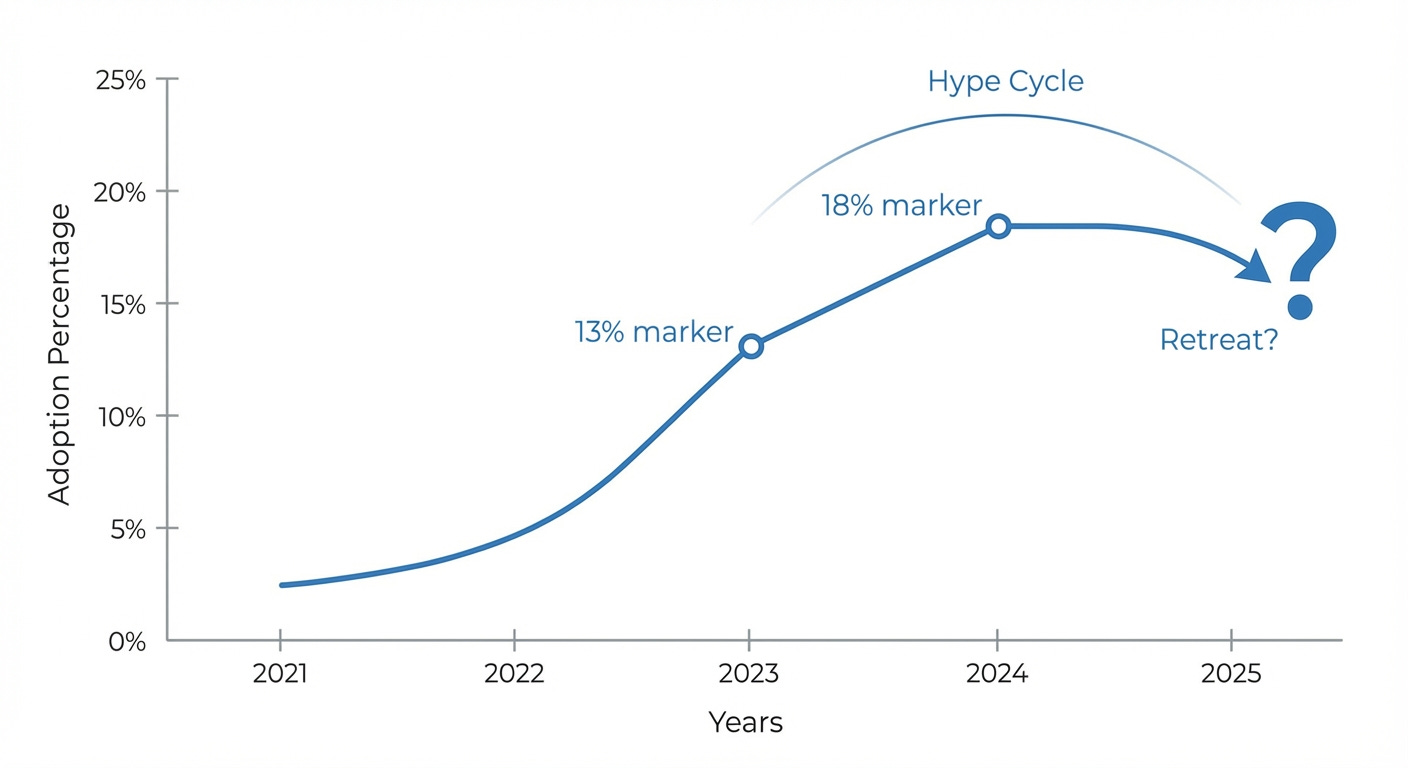
Data mesh was supposed to fix this. By decentralizing ownership and treating data as a product, organizations could escape centralized bottlenecks.
Gartner has already started walking it back: data mesh will likely be "supplanted by complementary approaches before reaching mainstream adoption", no more hype.
Why? Only 18% of organizations have the governance maturity required to make data mesh work. Cultural resistance, not technical complexity, is the primary barrier. Data mesh requires buy-in from C-suite executives, data engineers, analytics engineers, domain teams, business analysts, and product managers. Without that alignment, it creates frustration and encourages shadow IT.
The same pattern played out with microservices. They promised modularity, independent deployment, and team autonomy. According to a 2025 CNCF survey, 42% of organizations that adopted microservices have now consolidated at least some services back into larger units (… normal “services” ¯\_(ツ)_/¯).
Segment went from 150+ microservices to a single application. At SpringOne 2024, one engineer reported migrating 47 microservices back into a monolith: deployment time dropped from 40 minutes to 6 minutes, cloud costs fell 63%.
Distributed architectures aren't bad. They're demanding. They require coordination capacity that most organizations don't have.
The human cost
Behind every fragmented data architecture, there are data engineers trying to hold it together.
Data engineering has a burnout problem. Stack Overflow and industry surveys consistently report that data engineers face high rates of exhaustion and turnover intent. The causes won't surprise anyone who has worked in this space: too much time fixing errors, repetitive manual tasks, and a constant stream of unrealistic requests from stakeholders.
When data schemas become rigid because changing them requires coordinating with a dozen downstream systems, that's not a technology constraint. When marketing dashboards rely on stale data, that's not a pipeline problem. That's a prioritization failure. When customer service can't reconcile records between CRM and order history, that's not a data model issue. That's a governance gap.
Your technology stack absorbs organizational dysfunction. It doesn't resolve it.
Kafka can't fix a reporting structure. Iceberg can't make stakeholders stop asking for unrealistic timelines.
What actually works
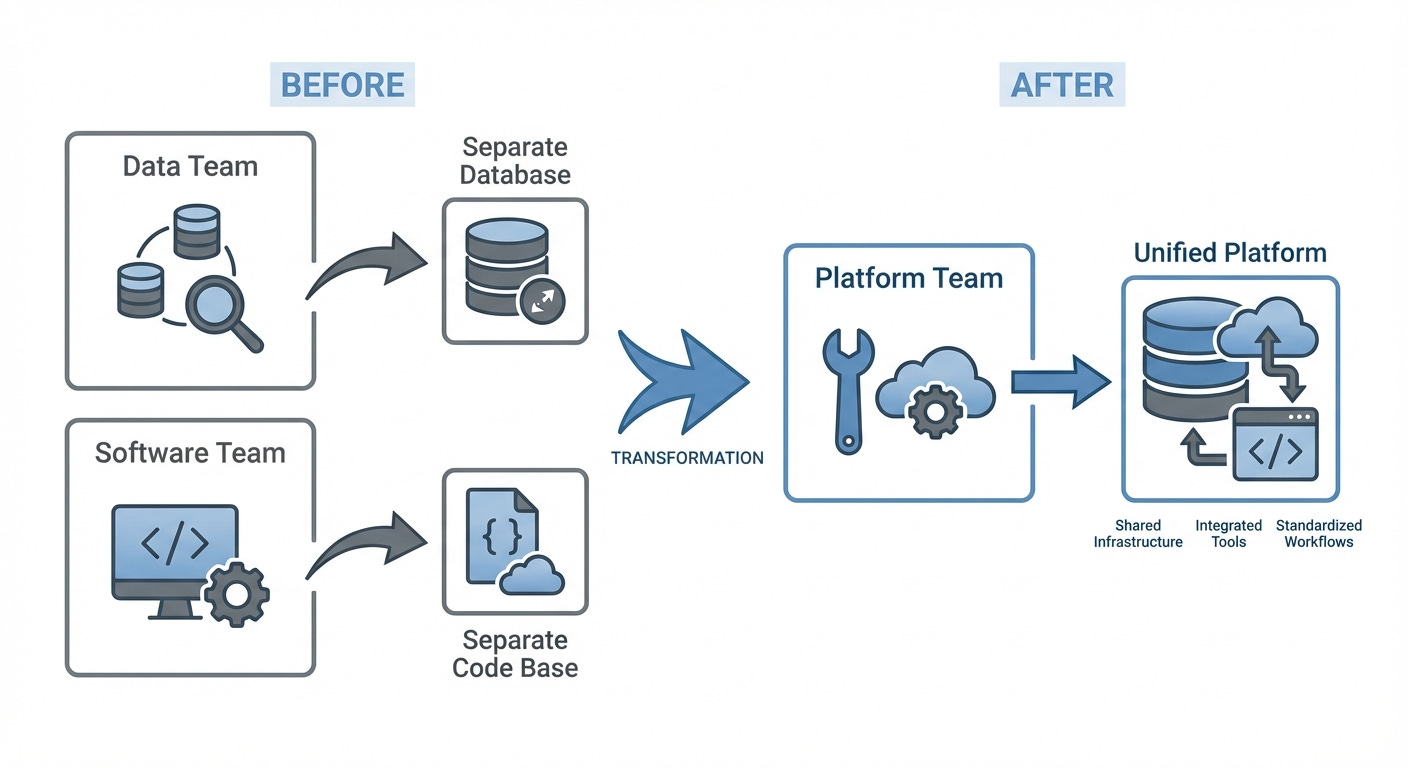
Martin Fowler describes the "Inverse Conway Maneuver": deliberately designing your organization to get the architecture you want, rather than letting your architecture emerge from existing dysfunction. Team Topologies provides a practical framework for this: stream-aligned teams, enabling teams, and deliberate interaction modes.
If you want unified data, put data engineers and software engineers under the same reporting structure. If you want consistent customer data across marketing, sales, and product, make them share ownership of it. If you want real-time analytics that stays in sync with operational systems, make the same team responsible for both.
Interviews with data practitioners who led large-scale migrations revealed a hard truth: "Migrations are more about people than data". The biggest challenges weren't moving records. They were untangling undocumented logic, avoiding stakeholder frustration, and catching discrepancies before they snowballed.
Ask yourself:
Do data and software teams share goals? If they report to different executives with different KPIs, unified tools won't unify them.
Who owns the customer data model? If the answer is "nobody" or "everybody" or “what is a customer here?” (each department can (will) have their own definition) you have a governance problem, not a technology problem.
Can you change a schema without a two-month approval process? If not, your architecture is already calcified. New tools will calcify in the same patterns.
Would your organization adopt this architecture even if you didn't mandate it? If the answer is no, you're fighting your own communication structures.
If you can't restructure the org
Most engineers can't restructure reporting lines. That's a reasonable objection. But there's incremental work you can do without executive authority.
Map your data lineage to your org chart. Literally draw both, overlay them. Every crossing line is a coordination cost you're paying. This makes the invisible visible. Show it to your leadership.
Start with data contracts. Define explicit agreements between teams about schema, quality, and SLAs. This creates accountability without restructuring.
Rotate data engineers into domain teams. Embedding creates relationships that survive after the rotation ends. Relationships reduce coordination friction.
Pick one domain and unify it. Create a single owner with authority to approve schema changes for customer data, or product data, or transactions. See if it works before scaling.
Use platform engineering patterns. Internal developer platforms reduce coordination overhead by providing self-service capabilities. Team Topologies calls these "platform teams".
The goal isn't to reorganize the company. It's to incrementally reduce coordination costs until the architecture can evolve without breaking.
Before you migrate
Before you adopt Kafka and Iceberg (or whatever comes next), ask: "Would the same dysfunction reproduce itself?"
If your data team and software team don't talk today, unified streaming won't make them talk. If marketing runs shadow analytics because they don't trust central data, a new lakehouse won't earn their trust. If schema changes take months because nobody owns the coordination process, Iceberg's schema evolution features won't help.
Technology enables. Transformation requires changing how people work together. Either you remove people or you reorganize how they work. This is brutal. Fixing reporting structures. Aligning incentives. Building trust between teams that have spent years learning to work around each other. Nobody wants to do it. That’s why they keep buying platforms instead.